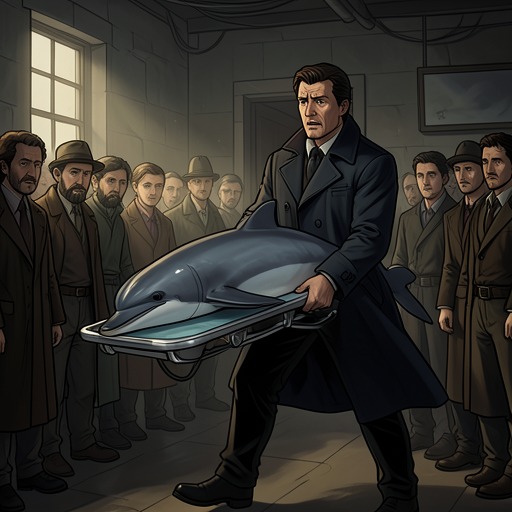
Jasper Is Attacked by a Dolphin and Rescues It
Made for LoveJasper Is Attacked by a Dolphin and Rescues It is a violent beach encounter that turns an attempted retreat into an unlikely rescue and a public spectacle. Jasper enters the water wanting silence and escape; after a dolphin batters and submerges him, he fights back to the shore with the animal, only to find a crowd recording him. The episode’s reversal—from helplessness in the water to anonymous celebrity on land—begins a new public identity he neither sought nor welcomes.
The Sunset Swim and First Blow
Jasper has decided to leave and take in one last sunset by the ocean before packing up. The sun appears to melt smaller and thinner toward the waves, while the heat remains trapped overhead. He walks into the water until it rises to his shoulders and chin, then goes limp and floats. With his ears submerged, he enjoys what he calls a “lobotomized feeling”: the outside world disappears beneath the steady beat of the water. In that suspended quiet, his groin begins to swell with a halfhearted erection.
The solitude ends when something strikes him in the face with enough force to drive his whole body beneath the surface and slam him into the ocean floor. Jasper knows he should panic, but initially finds movement difficult. In his head, an affectless female voice repeats “suffocation,” pronouncing the word with the composure of a spelling-bee contestant. The mismatch between the calm voice and his bodily danger makes death seem almost seductive: he imagines it encouraging him, in an arousing tone, to stop fighting. Gradually his limbs return, tingling and painful, and he manages to sit up and reach the surface for air. The attacker remains unknown, leaving him to wonder what has happened.
Repeated Attack and the Dolphin’s Reveal
When something noses his groin, Jasper interprets the danger through his fear of Elizabeth. He imagines her in scuba gear on the ocean floor, holding piano wire and preparing to castrate him. His immediate objective is simply to get back to shore, but as he starts swimming he feels himself painfully goosed and is launched several feet forward, his head driven underwater. In raw distress, he cries, “Moley E., please!”—accidentally using the secret-joke name associated with Elizabeth. His panic rapidly turns the slip into a fresh imagined catastrophe: he thinks he has convinced her to take his manhood and pictures himself ending his life as a eunuch. He even wonders whether a tender appeal to her by name might have changed the outcome.
The next assault is more sustained. Jasper is pulled under again as repeated, heavy thrusts strike his torso and hold him beneath the water. Nearly a minute passes before he can identify what is attacking him. His vision dims pale pink at the edges as oxygen deprivation sets in; he briefly welcomes the fading sensation as a chance to rest. The assailant is neither Elizabeth, a shark, nor another imagined monster, but a dolphin. Jasper recognizes the animal by its exterior even as he cannot understand why it is attacking him. The abrupt identification replaces the threat he has been inventing with a real, forceful animal encounter.
As he nears asphyxia, his mind turns to an earlier dental appointment. He recalls a hygienist helping him breathe through a nitrous oxide mask and remembers having entertained the possibility of intimacy with someone who seemed capable of taking charge and giving him a break from his performed routine. But when she drew close, he asked about her annual income and dismissed the prospect of flirting because he thought she did not earn enough. She put the mask back over his mouth, and the dalliance ended. In the present crisis, that memory brings together his longing to relinquish control and the calculating habit that interrupted it; the recollection does not stop the attack, but it occupies his mind while his body is running out of air.
Hauling the Animal Ashore
After surviving the underwater struggle, Jasper decides that the dolphin cannot simply be left in the sea. He worries that it may have exchanged pathogens with him and reasons that the aggressive animal needs testing. His thoughts jump between possible ways to transport it: the trunk of his car, a rope tying it to the roof, or a direct trip to the emergency room. He also frames the day as a run of bad luck, linking the encounter to his earlier distress at seeing Elizabeth after their motel episode. Reaching land, he thinks, would let the strange day end and allow him to wake feeling lucky again.
Getting the dolphin to shore becomes an ordeal in its own right. The animal feels impossibly heavy, and Jasper is exhausted by the battle, whose duration he cannot estimate. As he shuffles forward, the dolphin’s glossy back reflects his face. Jasper recoils at the sight: he looks old. For a moment he cannot accept the reflection as his present appearance and reads it as a glimpse of his future, at odds with the eternally young self-image fixed in his mind. Despite the weight of the animal and his bleeding wrist, he keeps staring. The rescue thus carries a private shock alongside its physical burden: Jasper confronts an image of age that his usual self-conception has excluded.
When he finally looks up, the two are no longer alone. A line of people fills the shore, their arms extended toward him, each holding a Gogol cell phone to take photographs or video. A woman cries, “You saved the dolphin!” Jasper tightens his shoulders and answers, “No big deal,” minimizing the feat even as the crowd turns it into a scene. His modest phrase will soon become the caption attached to his image.
Anonymity and the Viral Rescue
Jasper places the living bottlenose dolphin on the sand and runs as soon as he can. His legs shake with exertion, but the crowd gathers around the animal, assuming that he has gone to get help; their attention gives him the chance to slip away. A bystander offers him a ride to an ocean-creature clinic in exchange for gas money, but Jasper does not stay to accept it. He returns to his old motel room without being followed, with the dolphin itself serving as a distraction from the man who had carried it ashore.
That night Jasper wakes in time to see himself on the local news. An elderly woman compares the rescue to a pietà, reenacting his emergence from the water with her arms and likening him to Jesus carrying a dolphin; an intoxicated tourist in the background announces that he is on television. The coverage reports that the dolphin is in good health, had become separated from its pod, and might have stranded farther down the shore without the intervention of the unidentified man now being called “Dolphin Savior.” Jasper has not yet been identified, but the story has already spread online. A photograph of him holding the dolphin bears the words “NO BIG DEAL,” and a five-second clip of him saying the phrase has millions of views.
The coverage makes Jasper’s escape from the beach temporary: though no one knows his name, the image of his wet shorts and the rescue has made him an object of public attention. News commentators speculate about his appearance and joke about staging a rescue to meet him, while Jasper wonders what is wrong with everyone and recognizes that he will not solve the riddle. He chooses to rest before an incognito relocation the next day. The encounter has therefore produced an irony more consequential than a fleeting headline: Jasper saves an animal while trying to get away from the scene, then discovers that the rescue has made him famous precisely when he wants to disappear.